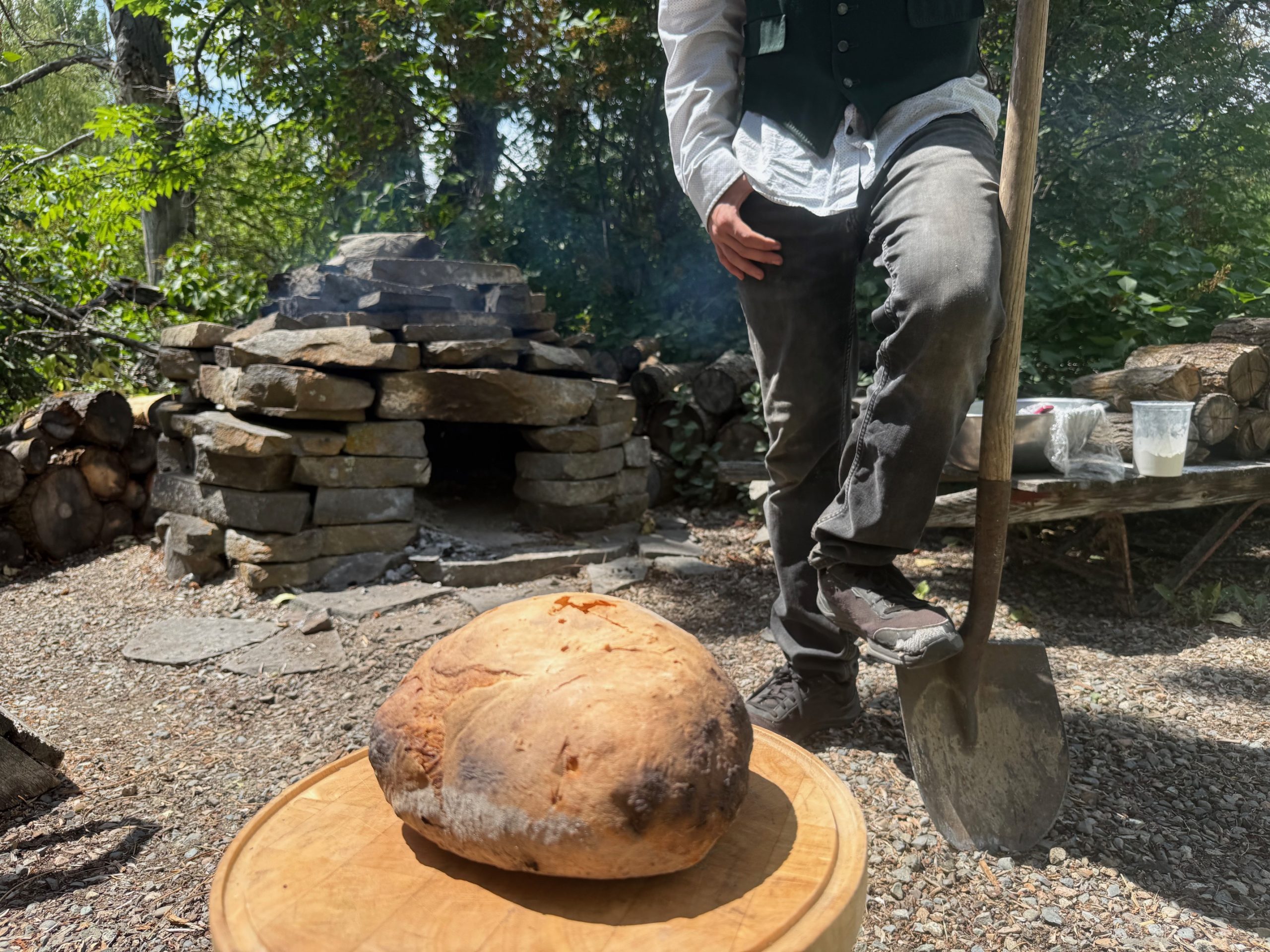
The Grist Mill’s heritage cooking workshops were designed around a simple insight: some forms of knowledge can’t be meaningfully absorbed by watching, reading, or listening alone. They need to be felt in the hands, paced in the body, and learned through repetition and shared effort. Cooking—especially using historical techniques—became one of the most effective interpretive tools we had.
The workshops focused on foundational food skills that once sat at the centre of everyday life: bread baking in a stone oven, butter churning, condiments and preserves, heritage desserts, and seasonal cooking techniques tied to agricultural cycles. Participants didn’t just observe these processes; they performed them. They mixed dough, judged texture by feel, adjusted for temperature and humidity, and learned why recipes from another era assumed a level of intuition modern cooks are rarely asked to develop.
My role encompassed curriculum design, historical research, recipe development, sourcing ingredients, and leading the workshops in real time. Each session required balancing historical accuracy with practical success—honouring traditional methods without setting participants up for failure. The goal was confidence rather than perfection, and understanding rather than reenactment. Much of that confidence came from understanding why techniques worked the way they did. When participants understood what fermentation was doing, why temperature mattered, or how fat behaved in a dough, they were far more willing to experiment and troubleshoot on their own. Knowing the reasoning behind a method mattered more than memorizing steps.
What made the workshops effective was their refusal to oversimplify. We didn’t strip away complexity in the name of accessibility; instead, we framed it clearly. Participants left with usable skills, historical context, and a deeper appreciation for the labour and judgment embedded in everyday food. Many returned repeatedly, bringing friends or family, and some went on to apply the techniques in their own kitchens and communities.
Operationally, the workshops functioned as both public programming and skills development for the site itself. Techniques refined through teaching fed directly into Sunday Dinners, catering menus, preserves production, and seasonal events. The workshops also built trust—participants understood the care and expertise behind the food they later encountered at the site.
The workshops showed how historical practice becomes living knowledge when people are trusted to do real work with their own hands. Interpretation can be tactile, social, and rigorous at the same time. Teaching people to make something meaningful creates a connection to place that endures far longer than information alone.