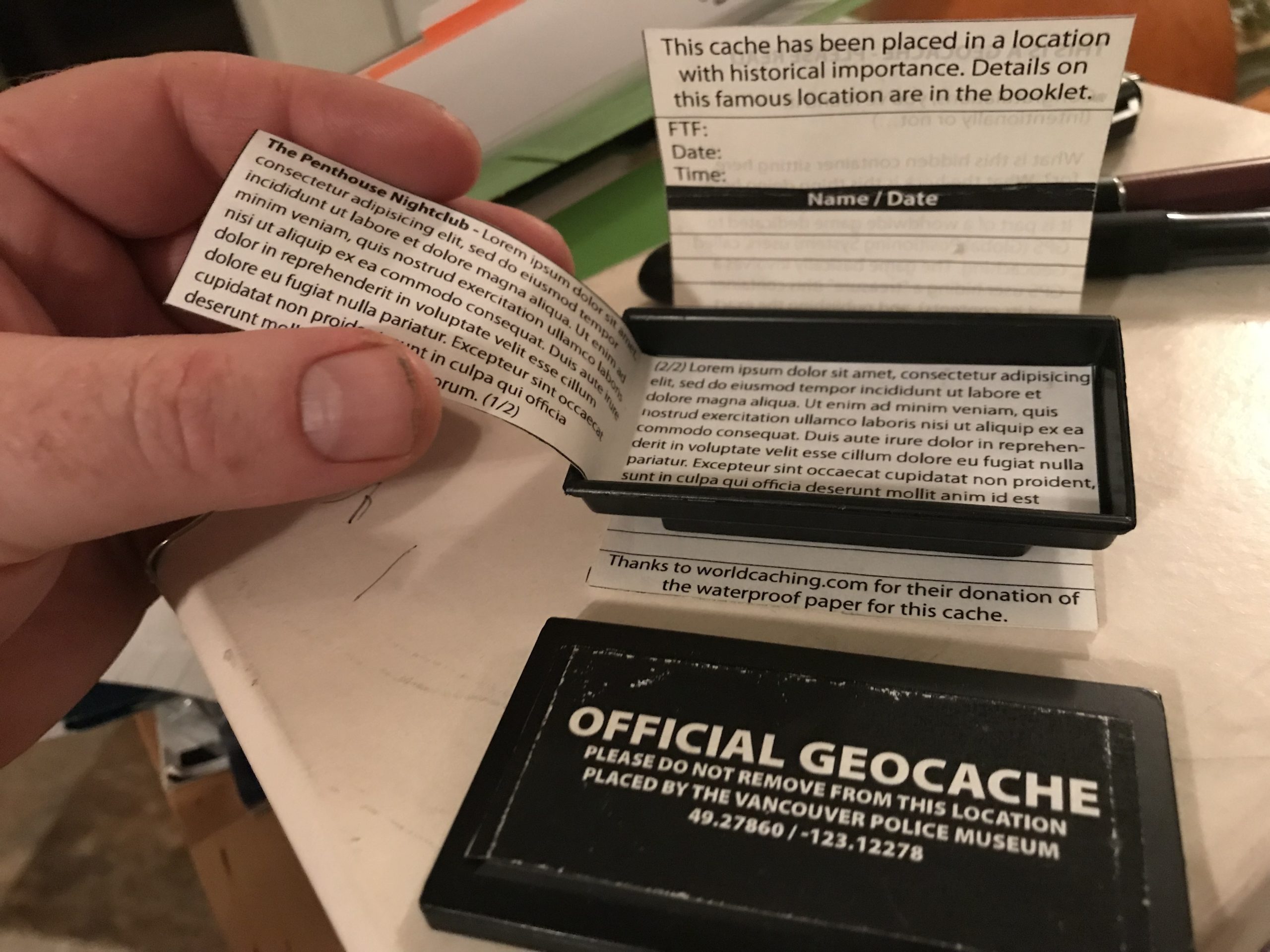
Just before the 2010 Winter Olympics, I developed a series of historical geocaches placed throughout Vancouver at locations with connections to the city’s crime history and policing heritage. The aim was to test a simple hypothesis: could location-based technology get people to actually see a place, not just visit it?
Each cache contained information about geocaching itself, details about the Vancouver Police Museum, and historical context about the specific location. The cache boxes were labeled “OFFICIAL GEOCACHE – PLEASE DO NOT REMOVE FROM THIS LOCATION – PLACED BY THE VANCOUVER POLICE MUSEUM” with coordinates, giving them legitimacy within the geocaching community while clearly identifying the museum’s role.
What made this work was the progression I watched play out over and over: geocachers would arrive staring at their phones, GPS-focused and narrowly intent on finding the container. Once they opened the cache and read the contents, something shifted. They’d pause, look up, and actually see where they were—standing in the oldest alley in Chinatown, outside a famous strip club with its own notorious history, or in front of Vancouver’s former CSI lab and morgue. The cache became the mechanism that prompted them to engage with place and history they might otherwise have walked right past.
The program worked because it operated on the geocaching community’s terms rather than trying to force an institutional agenda onto their activity. Geocachers are highly sensitive to outsiders using the platform for self-promotion, so we were careful to foreground history and place rather than the museum itself. We weren’t asking them to visit or sign up for anything—we were offering context at the moment and location where it was most relevant, trusting that interest would follow on its own terms.
The initiative ran through the Olympics and beyond, reaching an audience—tech-savvy, mobile, interested in exploration and discovery—that aligned well with the museum’s programming but might never have thought to visit a small heritage institution. It demonstrated that museums could participate in emerging location-based platforms without compromising their educational mission, and that sometimes the best interpretation happens outside museum walls. What mattered was creating a reason to pause, look up, and actually see where they were.