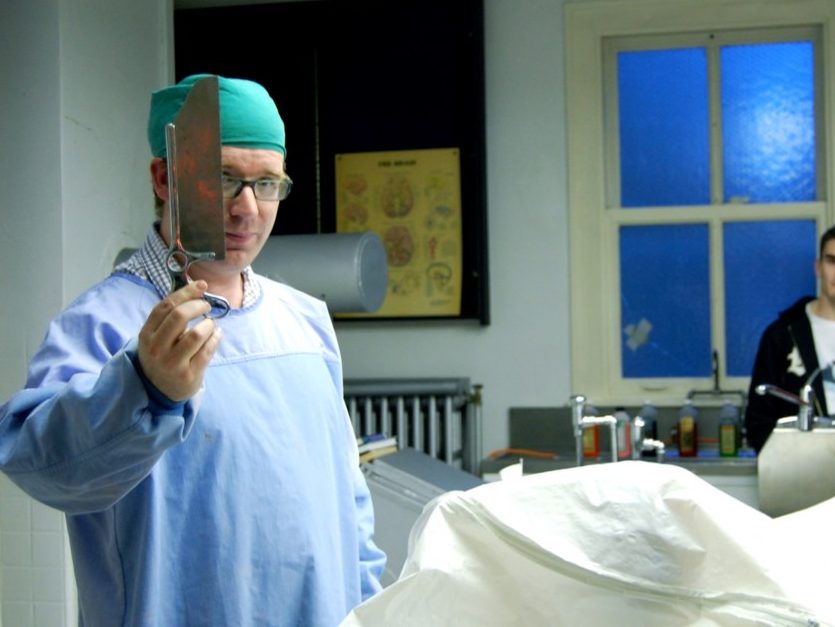
In spring 2010, I developed and launched a series of forensic science workshops for adults at the Vancouver Police Museum—finally answering the persistent demand from visitors who wanted the hands-on programming we’d been offering kids, but with content that didn’t pull any punches. The workshops were an experiment in treating public programming like continuing education: technically accurate, genuinely engaging, and designed for people who wanted to learn something real rather than be passively entertamed.
The first workshops covered forensic pathology, blood spatter analysis, and ballistics. The pathology session made full use of our setting: the museum is housed in Vancouver’s former morgue and autopsy facility, where nearly 15,000 autopsies were performed. Participants got up close with the original tools—head clamps, bone saws, the works—while walking through the investigation process from crime scene to funeral home. The blood spatter workshop became a particular favourite. There’s something clarifying about learning to read the physics of violence—angle of impact, directionality, the difference between cast-off and arterial spray—in a room full of curious adults who showed up on a Tuesday evening specifically to learn this.
Popular crime and forensic media had created a real appetite for this material, and it was my job to feed that curiosity while expanding it into a broader view of what’s possible to notice when you pay the right kind of attention. I’ll never forget that blood spatter workshops were often “date night” for couples. The depth of the workshops quickly became apparent in unexpected ways. The success of the series led to speaking invitations, including a keynote at a writer’s conference where 300+ authors wanted to know how to include authentic forensics in their plots. The talk itself went well. The Q&A, however, devolved into writers presenting increasingly gruesome scenarios—their imaginations were fertile—and asking what evidence might be left behind.
Ethically, these workshops stayed with abstract theory and principles, avoiding application to current cases or anything real and specific. We kept it detached and interesting, but with a gentle reminder that in real life these skills are deployed in heartbreaking situations—just enough to ensure respect, even as we peered behind the curtain at forbidden knowledge. The line between education and voyeurism required constant attention, and the setting helped: the actual morgue, the actual tools, the actual history all grounded the work in something more serious than entertainment.
The workshops proved that seriousness was the draw, not a barrier. Adult audiences didn’t want watered-down content or theatrical performance. They wanted intellectual respect, technical depth, and access to systems most people never see. When you treat curiosity as legitimate—even when uncomfortable—you build trust. Trust keeps people coming back.