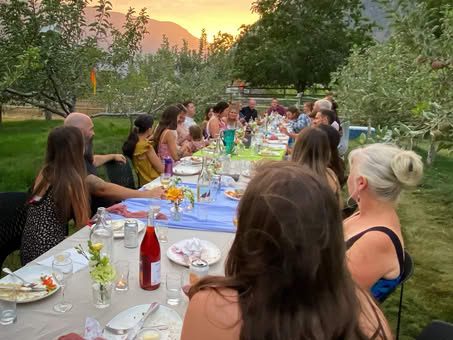
The Grist Mill’s Sunday Dinners began as an experiment in using food as interpretation—an attempt to create a shared, unhurried experience that felt more like being invited into someone’s home than attending a formal event. They also became, unexpectedly, the place where I discovered that I could cook at scale, with consistency, and under real constraints.
In the early years, I did much of the cooking myself, designing menus and executing them in a small, barely-commercial kitchen with limited equipment and storage. As the program matured, a support team gradually formed around it, but the core approach remained the same: one-off seasonal menus built from scratch using ingredients grown on site, sourced from Similkameen Valley farmers, or preserved earlier in the year. Guests didn’t order from a menu; they accepted the meal as offered, which shifted the experience from transaction to participation.
The dinners were also a deliberate response to a regional trend toward expensive, wine-paired dining experiences that often felt exclusionary. Our counterpoint was simple: quality food and meaningful hospitality didn’t need to be precious or expensive. An informal rule of thumb guided menu design—five ingredients only. We often joked about Coco Chanel’s famous fashion advice: “Before you leave the house, look in the mirror and take one thing off.” The same principle applied in the kitchen. Fewer elements, executed well, told a clearer story than fussy plates.
Attendance grew steadily. What started as a single dinner with sparse turnout evolved into a dependable series with a loyal following. By 2025, we doubled the program from bi-weekly to weekly service and increased average attendance from roughly 20 guests per dinner to approximately 50, while maintaining quality, affordability, and atmosphere. The dinners became both a social anchor for the community and a reliable earned-revenue stream during the operating season.
Sunday Dinners became the place we tested everything else. A technique we developed for a dinner menu would show up in a wedding. A sourcing relationship would scale to catering. The program let us experiment with real guests, real feedback, and low stakes before committing larger resources.